
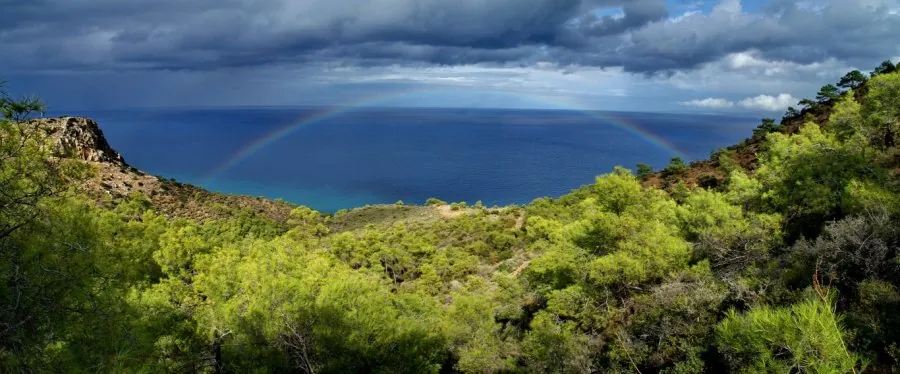
Built 270 m above sea level and comprising 137 rooms, Vouni Palace was commissioned in the 5th century by Doxandros of Marion, the pro-Persian king of the city of Marion, in order to control the nearby pro-Greek settlements (the city of Soli).
Burned by the people of Soli in 380 BC, Vouni Palace was never rebuilt. Excavations uncovered items known as the “Vouni Treasure” inside a terracotta jar blackened in the fire that destroyed the palace. Among them are gold and silver bracelets, decorated silver cups and hundreds of coins bearing the stamps of the cities of Marion, Kition, Lapithos and Paphos.
On the island of Petra tou Limniti, visible from Vouni, archaeologists have found traces of pre-Neolithic settlement. To the south of the palace, traces have been found of a temple of Athena built at the end of the 5th century BC.
The surviving sections of Vouni include the entrance, royal chambers, colonnaded courtyard, kitchen courtyard, cistern, storerooms, baths, living rooms and workshops.
The Vouni Baths are among the earliest examples of the hot-bath type.