
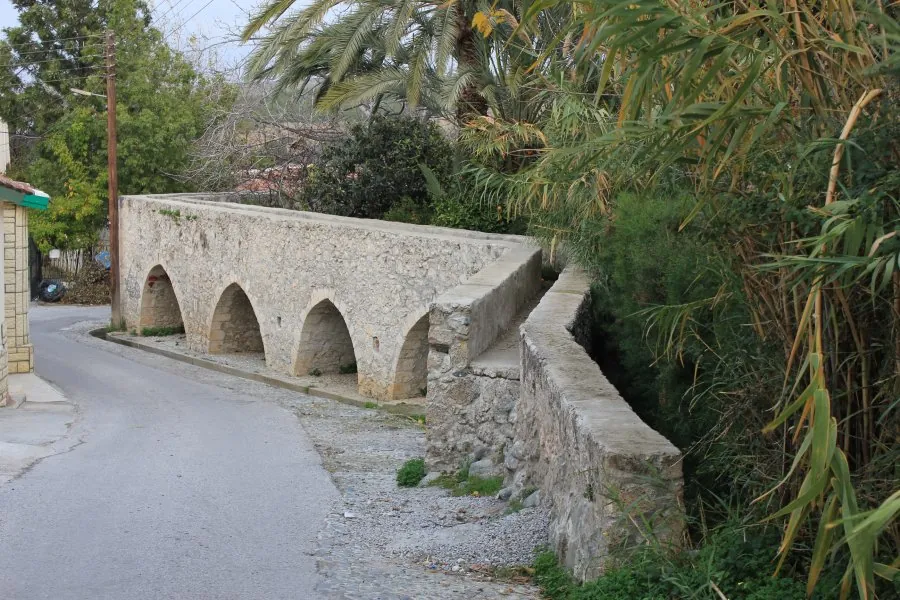
To make efficient use of Lefke’s water there are aqueducts from both the Venetian and the Ottoman periods.
With fertile fields stretching down to the sea, Lefke was one of the grain-producing centres of the Ottoman period. For this reason many mills were built to grind the grain, along with the water channels needed to drive them. Separately, water coming from the Troodos mountains was distributed throughout the town by channels in order to irrigate the citrus groves.
Today the water channels running alongside some of Lefke’s roads, and the aqueducts that here and there display Ottoman stonework, are striking.
Sir Samuel Baker, who visited Cyprus in 1879, wrote that the stonework of the watercourses feeding the water mills he saw in Lefke was elegant and decorated with interlacing patterns. Only ten of these aqueducts, however, have survived to the present day.
The aqueducts of Lefke were built by El Hac Ali Efendi ibn Ebubekir Efendi and were included in the Ebubekir Efendi Endowment established in 1102 AH (1690).